Click here to see my latest in the Series “Unseen” with Unseen Lipscomb, Alabama – Amazing! In this episode, we take a closer look at Lipscomb—a small town that many people pass through without ever …
Click here to see Bessemer, Alabama in a whole new light – Unseen Bessemer! Is Bessemer one of the most overlooked towns in Alabama? In this video, I take you beyond the usual routes to …
Click here to see my latest Short Film of the beautiful Southern City of Calera, Alabama! Step off the main road and discover a side of Calera, Alabama most people never see. In this episode …
Click here to see my latest Short Film on Decatur, Alabama – seldom seen parts of the city! Decatur, Alabama has a lot more going on than most people realize—especially along Bank Street, one of …
Click here to see my latest Short Film on Unseen Hartselle! Most people pass through Hartselle, Alabama without ever slowing down—but just beyond Main Street, a different story unfolds. In this urban hiking episode, I …
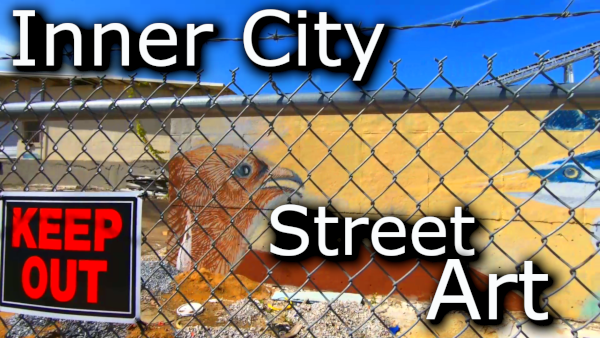
Today I explore Inner City Street Art, Graffiti and More in downtown Birmingham, Alabama.
Birmingham, Alabama’s inner city street art and graffiti was simply beautiful. I realize that graffiti and street art to some is just vandalism in many cases. But this did not seem like the case as I explored the inner city of Birmingham, Alabama’s street art and graffiti.
Some might even say that a better description of Street Art would be to call them murals. But as I explore the inner city of Birmingham for this stuff I prefer to see them as street art. Street Art itself could include graffiti but has a broader scope of possibilities.
Many of these look as though the street artist used spray paint for tagging buildings and doors.
So I hope you like my latest Urban Hiking Exploration of Birmingham’s inner city as I look for Street Art, Graffiti and more!
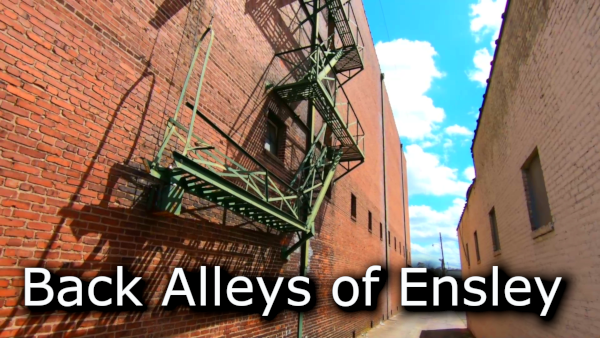
The back alleys of Ensley were a great way to move from block to block without the worry to heavy traffic.
The back alleys of Ensley revealed a lot of better days but also hinted of a city that could make a rebound.
Anytime I’m exploring the back alleys of a city I’m also aware that you are alone and must be careful and be aware of your surroundings. But if you’re willing, you can see a lot of a city on foot that you’d miss if you stayed in your car.
So I hope you like my latest video as I go explore the beautiful city of Ensley, Alabama and it’s interesting back alleys!
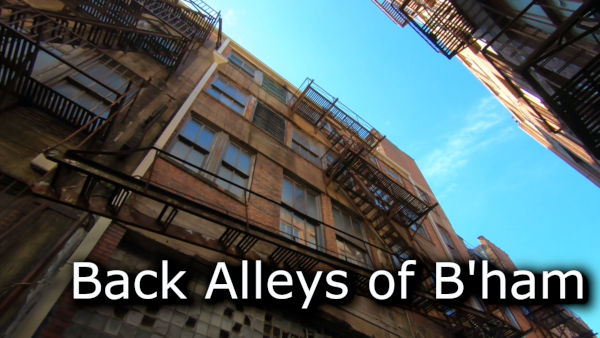
Join me for another urban exploration adventure as I go exploring the back alleys of Birmingham, Alabama! Was this a good idea?
As it turns out I think it was! Urban Exploring the back alleys of Birmingham was a gold mine in Urban Exploration as there were so many things to see.
As I was urban exploring the back alleys of Birmingham, Alabama I found all kinds of murals and what I consider other urban art – like the hood of an old car as a porch roof.
So was it a good idea? Yes it was and I hope to go back to do some urban exploring of more back alleys of Birmingham, Alabama!
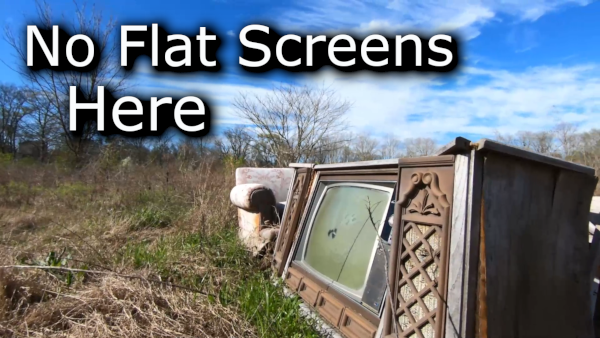
In my latest micro-adventure there were no Flat Screens found but I did find a lot of cool stuff in Harpersville, Alabama. I’m calling it – No Flat Screens Found…But I Did Find Some Cool Stuff! Harpersville, AL
I decided to just take a few random roads to see what I could find exploring rural Harpersville, Alabama. Some things were vacant, abandoned, inhabited and everything in-between.
Cool stuff can often be found in your own hometown or nearby just like there was in Harpersville, Alabama!
So let’s go find some cool stuff – no flat screens – in Harpersville, Alabama as I go exploring in the rural countryside of Harpersville, Alabama.
I’m calling it – No Flat Screens Found…But I Did Find Some Cool Stuff! Harpersville, AL
In this video I go Urban Hiking in the 2nd most dangerous city in the US, according to ourwovenjourney.com. It’s also the home of the original Mardi Gras – Mobile. Alabama! What?
I’m calling this one “2nd MOST DANGEROUS city in America? Home of the ORIGINAL Mardi Gras!”
Mobile is the oldest city in Alabama, founded in 1702 and home of the original Mardi Gras that started around 1703.
As stated on the mobilecarnivalmuseum.com site – 1703- Mardi Gras observed for the first time in the New World by French pioneers at Twenty-Seven Mile Bluff, the first settlement of Mobile.
I must personally say that I don’t know where ourwovenjourney.com got their statistics to say Mobile is the 2nd most dangerous city in the US… While Mobile has it’s share of homeless wandering around, as do most cities, I never felt in any danger and I was walking everywhere.
In fact, I wouldn’t think twice about visiting mobile as it seemed perfectly safe to me and there were plenty of police patrolling the downtown area. Maybe Mobile has it’s high crime areas, as most places do, but again, I had a great time and NEVER felt unsafe in any way! I would encourage everyone to visit Mobile, Alabama as I think you’ll love it!
According to encyclopediaofalabama.org – Founded by the French in 1702, Mobile is Alabama’s oldest city and a major port facility for the region. The city’s three centuries of history have been inextricably tied to the development of its port and the economic prosperity of the adjoining area. The city hosted the first Mardi Gras festivities in North America and has a rich cultural heritage. Mobile was the final destination of the last enslaved Africans brought to the United States shortly before the outbreak of the Civil War. During the turbulent years of the civil rights movement, Mobile earned a reputation of tolerance in part because of the absence of violent demonstrations seen in many southern cities. Today, Mobile continues to serve a crucial economic role as a major port facility for the state and region. Notable people from Mobile include baseball greats Satchel Paige, Billy Williams, Willie McCovey, Hank Aaron, and Ozzie Smith. Famous figures in the arts include James Reese Europe, John Augustus Walker, Eugene Sledge, Eugene Walter, and Julian Lee Rayford.
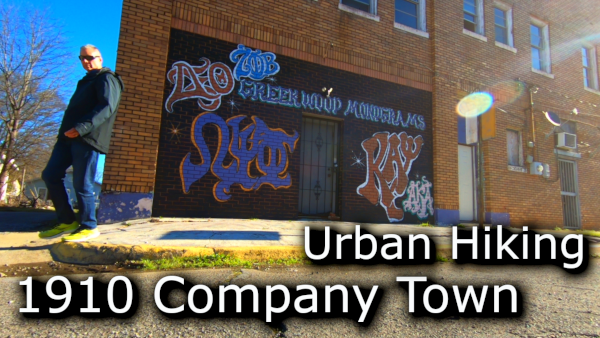
In today’s Urban Hiking adventure I go hiking in the 1910 Company Town built by US Steel in Birmingham, Alabama – Fairfield. I’m calling it – 1910 Company Town – An Old City Reborn? Fairfield, Alabama!
According to the Fairfield Housing Authority website:
Historic Town of Fairfield
Fairfield Alabama, founded in 1910, is located southwest of Birmingham in Jefferson County. The city was a planned company town, founded by United States Steel (U.S. Steel), which had purchased the Tennessee Coal, Iron and Railroad Company (TCI) in 1907. The town initially was named Corey, after U.S. Steel president William E. Corey.
It was organized and built by Birmingham developer Robert Jemison Jr., who formed the Corey Land Company in 1909 for those purposes, hiring Boston landscape developer George H. Miller to design the space.
U.S. Steel officials decided to rename the town Fairfield in 1913 after the Connecticut hometown of another U.S. Steel executive, James A. Farrell. It was incorporated on January 1, 1919. The Corey Land Company also became known as the Fairfield Land Company and continued to develop the town.
A city hall was constructed in 1945 with Works Progress Administration funds, and the town’s population would continue to expand into the 1950s. As the steel industry began to decline, with plant closures, production slowdowns, and stoppages over the following decades, Fairfield’s population fell as well. Construction of Interstates 20 and 59 in the 1960s and 1970s required the demolition of the northern edge of Fairfield’s residential section closest to the steel plant.
Fairfield, however, still retains some of its industrial roots. Hanna Steel Corporation built a manufacturing facility in 1983, and Fairfield Works remains in operation, producing raw steel and manufacturing tubular steel products. It is one of the largest remaining steel operations in the South.
According to 2018 Census estimates, Fairfield recorded a population of 10,622.
Public education in Fairfield is administered by the Fairfield City School District. It oversees three K-5 elementary schools, one 6-8 middle school, a 9-12 preparatory high school, a 10-12 grade vocational school, and a K-12 alternative school. In addition, several private religious-based institutions collectively serve nearly 350 students. The historically black Miles College and Miles Law School are located in Fairfield.
Fairfield City Park features athletic fields and tennis courts, and the city oversees a community center. On the National Register of Historic Places are the Flintridge Building (1951), a former headquarters of TCI; the Miles Memorial College Historic District; and Parham Apothecary Building (ca. 1925). Fairfield’s proximity to Birmingham also provides numerous diversions for residents.
In this Urban Hiking micro adventure I find myself in the city of Talladega, Alabama which was founded in 1832! I’m calling it – Hope? Exploring the 1832 City of Talladega, AL! Any Hope – YES THERE IS!
Talladega is undergoing a huge change in their main street area downtown as you will see.
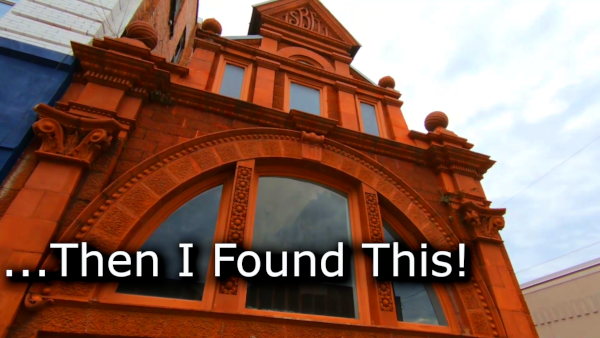
While urban hiking in Talladega, funded in 1832 I find this very interesting structure – it was just beautiful. It’s the one in my thumbnail. When I got returned home I researched it and this is what I found on the design200.org website:
Talladega- Isbell Bank
When terracotta is used as a building material, it is typically used only for ornamentation such as an embellishment around windows and doors. The Isbell National Bank in Talladega is a rarity, having been constructed in 1869 entirely out of red-hued terracotta. The bank is believed to be one of only five remaining architectural terracotta buildings east of the Mississippi River. Merchant James Isbell founded the bank in 1848, making it the oldest continually operating bank in Alabama. It is now called the First Bank of Alabama.
Other interesting facts about Talladega, founded in 1832:
According to mainstreetalabama.org:
Talladega received Main Street Alabama Designation in June 2022. Talladega’s priorities for the downtown district include: “ensuring the financial well-being of our city by promoting economic development; attracting business and industry; preserving and protecting the historic character; getting buildings up to code and securing tenants in vacant buildings; strengthening partnerships within and beyond the community; increasing pedestrian walkability for all users, including the blind; creating greater access to the newly formed entertainment district” to name a few.
According to ritztalladega.com related to the Ritz Theatre:
Talladega’s Ritz Theatre (circa 1936) is considered one of the best surviving examples of the Art Deco mainstreet theatres of the 1930′s.
Careful restoration of the landmark’s extraordinary facade – comprised exclusively of opaque structural glass, a common construction material used lavishly during the Deco period in buildings like the Rockefeller Center in New York City – was completed in late 1997 with perfectly matched antique vitrolite glass by renowned St. Louis artisan Timothy J. Dunn.
The historic Ritz Theatre reopened on February 16, 1998 as the premiere performing arts center of East Central Alabama with a concert by the National Symphony String Quintet.
Read this article from the 1930s about how the Ritz was the most modern theater in the Martin chain at it’s launch.
According to hmdb.org related to the historic courthouse:
The Talladega Courthouse was built in 1836 and is the oldest courthouse in continuous use in Alabama. The courthouse survived a tornado on May 11, 1912 that destroyed the clock tower, and a fire on March 13, 1925 that severely damaged the structure.
I’ll even travel to the world renowned – The Alabama Institute for Deaf and Blind
So I hope you like my latest Urban Hiking micro-adventure that I’m calling – Hope? Exploring the 1832 City of Talladega, AL! Any Hope – YES THERE IS!
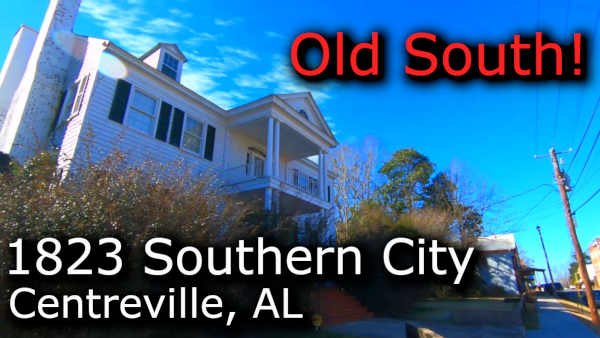
In today’s micro adventure we’re traveling back to the beautiful Southern city of Centreville, Alabama to explore the beautiful historical Southern homes! I’m calling this one – Exploring the 1823 town of Centreville’s Old Southern Homes 1832-1923!
Centreville was founded in 1823 on the banks of the Cahaba river.
Centreville is home to several beautiful old Southern mansions dating from 1823 to 1923.
This old Southern city of Centreville, Alabama located in Bibb County was founded in 1823.
Here is more information on the old Southern city of Centerville from
The seat of Bibb County, Centreville, was first incorporated on January 21, 1832. The town was built at the location of a waterfall on the Cahaba River and is noted for its historic district and courthouse.
Some of the historic landmarks you see in this micro adventure to the old Southern city of Centreville from the city of Centreville’s website:
Bibb County Courthouse
Built in 1902, the courthouse is the centerpiece of the town square in Centreville. The elegant building has undergone extensive renovation and preservation and is one of the busiest spots in the County. The Confederate Monument, dedicated in 1910 by the Leonard Callaway Pratt Chapter of the United Daughters of the Confederacy stands guard in front of the courthouse along with a memorial to WWII Medal of Honor recipient Ross F. Gray.
Davidson-Hobson House
The original house on Walnut St., Centreville, was built in 1837 by James Lafayette Davidson, an officer in the Confederate Army and a Probate Judge for Bibb County. According to legend and historical records, two Union soldiers were killed by Confederate snipers as they crossed the nearby Cahaba River Bridge, and they were interred on the property in an unmarked grave. Listed on National Register of Historic Places.
Henry-Kennedy House
Built in 1837 as a stagecoach stop and hotel called the Eagle Tavern. Yankee officers took over the hotel during the Civil War, and Federal Troops remained in the building for more than two years. John Perry Kennedy ran the inn until 1900 when it was purchased for a personal residence.
Oakley-Melton House
The former lodge at 568 Walnut St., Centreville, opened its doors in 1852 as a school building. Although the original structure burned in 1894, it was rebuilt and renamed Centreville High School until 1906, when it was purchased by O.C. Oakley for his residence.
Centreville Bank Building
Originally known as the Bibb County Banking and Trust Company, the bank was built in 1899. The three-story building originally housed a bank and the U.S. Post Office on the first floor and a hotel on the two upper floors.
So I hope you like my latest micro adventure – Exploring the 1823 town of Centreville’s Old Southern Homes 1832-1923!
In my latest micro adventure I go exploring in the old Southern city of Centreville, Alabama, founded in 1823! I’m calling it, Exploring the OLD 1823 Southern City of Centreville, AL!
This old Southern city of Centreville, Alabama located in Bibb County was founded in 1823.
Here is more information on the old Southern city of Centerville from
The seat of Bibb County, Centreville, was first incorporated on January 21, 1832. The town was built at the location of a waterfall on the Cahaba River and is noted for its historic district and courthouse.
Some of the historic landmarks you see in this micro adventure to the old Southern city of Centreville from the city of Centreville’s website:
Bibb County Courthouse
Built in 1902, the courthouse is the centerpiece of the town square in Centreville. The elegant building has undergone extensive renovation and preservation and is one of the busiest spots in the County. The Confederate Monument, dedicated in 1910 by the Leonard Callaway Pratt Chapter of the United Daughters of the Confederacy stands guard in front of the courthouse along with a memorial to WWII Medal of Honor recipient Ross F. Gray.
Davidson-Hobson House
The original house on Walnut St., Centreville, was built in 1837 by James Lafayette Davidson, an officer in the Confederate Army and a Probate Judge for Bibb County. According to legend and historical records, two Union soldiers were killed by Confederate snipers as they crossed the nearby Cahaba River Bridge, and they were interred on the property in an unmarked grave. Listed on National Register of Historic Places.
Henry-Kennedy House
Built in 1837 as a stagecoach stop and hotel called the Eagle Tavern. Yankee officers took over the hotel during the Civil War, and Federal Troops remained in the building for more than two years. John Perry Kennedy ran the inn until 1900 when it was purchased for a personal residence.
Centreville Bank Building
Originally known as the Bibb County Banking and Trust Company, the bank was built in 1899. The three-story building originally housed a bank and the U.S. Post Office on the first floor and a hotel on the two upper floors.
So I hope you like my latest micro adventure – Exploring the OLD 1823 Southern City of Centreville, AL!
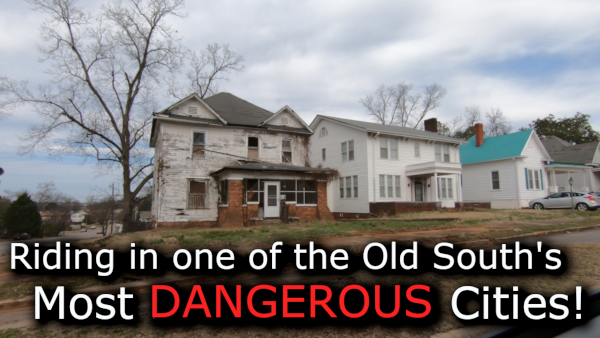
In today’s micro adventure I travel to one of the Old South’s most dangerous cities, I’m calling it – Riding in One of the OLD SOUTH’S most DANGEROUS cities! Ep – 38.
Whenever I explore cities like this I always wonder what things were like in their prime. But I also live in hops that one day they will see a revival.
While the crime rate in the most dangerous cites in America might be high we all know that the majority of the population are great people. They are hard workers making a living for their family. Typically the crime is subjected to certain parts of a city.
While traveling in Old Southern cities like this I have always felt very safe. The people have been nice etc…
That’s why I hope for a revival in many of these old southern cities.
So I hope you enjoy my latest adventure in the Old South that I’m calling – Riding in One of the OLD SOUTH’S most DANGEROUS cities! Ep – 38